
Apalachee East Release Meaning
Apalachee Correctional Institution, East Unit is an FDC institution. “Released from East Unit” can describe a move out of that building while state custody continues, or it can describe the end of the person’s prison interval. Those events require different records. A transfer to West Unit, Jackson Correctional Institution, a work camp, or any other FDC location belongs in the population and location history. A prison release belongs in the FDC release-only database.
For a completed state release, open the detail and compare the Release Date with the last Date Out-Custody in incarceration history. Then check Supervised Population. A same-day Supervision Begin Date can show that confinement ended and a community term began. If no supervision record appears, that alone does not prove unconditional discharge. Confirm the identity, sentence history, and any court or FDC record that explains the status.
| Question | FDC source | Key field |
|---|---|---|
| Still in prison? | Inmate Population | Current location |
| Released from prison? | Inmate Release | Release Date and out-custody history |
| Under supervision? | Supervised Population | Begin date, type, current status |
| Unavailable to supervision? | Absconder/Fugitive | Distinct absconder status |
Search Apalachee East Releases
The six-character DC number is the most reliable search key. It follows a person through population, release, and supervision systems even if a facility label or name changes. FDC also accepts last name, first name, and an alias option. Name fields use prefix matching. Open the detail and compare the birth date, aliases, photograph, physical description, offenses, and custody intervals before accepting the match.
A careful search uses each database for its own task.
- Search Inmate Population to learn whether FDC still reports a prison location.
- Search Inmate Release with the same DC number to find an actual or scheduled release record.
- Read the heading, Release Date, detainers, and incarceration history in chronological order.
- Open Supervised Population and compare the supervision begin date with the prison release date.
- When a transfer appears, follow the current FDC location instead of labeling the East Unit departure as release.
County-only jail stays do not appear in this FDC system. The Jackson County release search separates the county jail, state prison, juvenile, federal, and immigration paths when the last custodian is uncertain.
Apalachee East Record Details
FDC’s dedicated release database covers people who were released and those scheduled for release. It updates nightly. A future date is not the same as an actual departure. On the population page, the public label “Current Release Date” may show a date, “PENDING REVIEW,” or “TO BE SET.” Florida law describes the gain-time calculation as the tentative release date. The displayed value can change after awards, forfeitures, sentence changes, detainers, court action, or review.
An actual release detail may contain the name, DC number, photograph, race, sex, birth date, custody classification, Release Date, aliases, sentence history, detainers, and custody dates. The word “Custody” can refer to classification while confined. It should not be mistaken for a present custody label on a historical release page. The page heading and matching release and out-custody dates carry more weight.
- DC number
- The stable FDC identifier used across all offender databases.
- Current Release Date
- The public population-page projection, subject to change and review.
- Release Date
- The date shown on the historical release detail.
- Supervision Begin Date
- The start of an FDC community-supervision interval when applicable.
A stated residence, if listed, is an intended or reported destination. It does not establish the person’s current home. Likewise, a historical photo helps match identity but does not show present appearance or location.
Apalachee East Unit Contact
East Unit has its own street address and telephone number. It shares the institution office email and fax listed in the research with West Unit. Use “East Unit” in the request so staff do not route the question to the wrong building. For formal release history, the statewide FDC records route remains more useful than a general facility inquiry.
Apalachee Correctional Institution, East Unit35 Apalachee Drive
Sneads, FL 32460-4166
Phone: 850-718-0688
Fax: 850-593-6445
Email: ApalacheeCI.WardenOffice@fdc.myflorida.com
FDC’s Bureau of Admission and Release publishes 850-488-9167 and dc.release@fdc.myflorida.com for release-date matters. Classification and Central Records is available at 850-488-9859 for population or detail questions. Formal requests can use the FDC public-records page. State the full unit name, DC number, relevant dates, and exact record or field sought.
The county records portal is not the right custodian merely because the prison sits in Jackson County. Apalachee East custody is state custody, and FDC creates the public discharge trail.
Why Apalachee Unit Matters
An official FDC audit described Apalachee as two separate units, East and West. This is more than an address detail. When a historical paper lists only “Apalachee,” it may be unclear which unit held the person. A transfer between the units can create a location change without a release. Use the DC number and dates to reconcile the record, then ask FDC to identify the unit tied to the requested interval.
The official Apalachee East Unit directory page is the source represented below. It confirms the facility-specific contact, while the statewide offender network carries person-level release history.
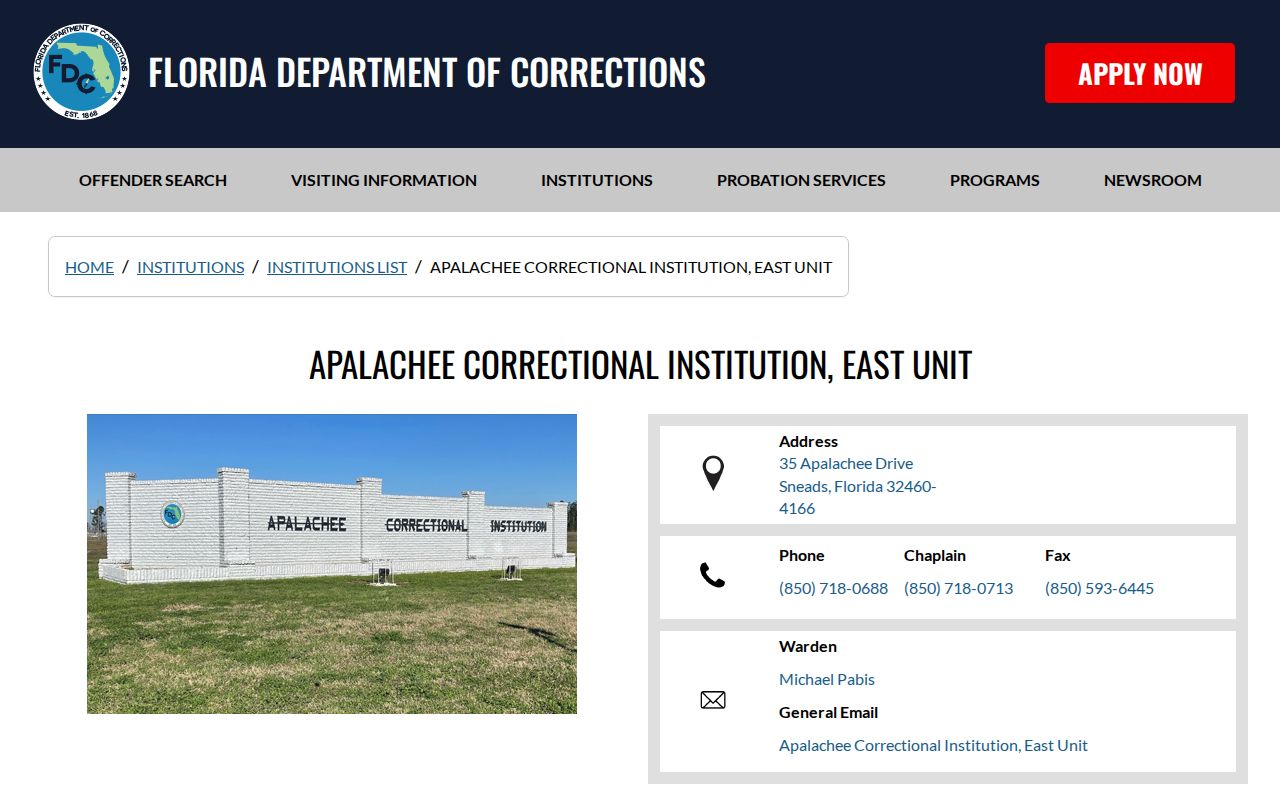
The screenshot helps distinguish East Unit from neighboring FDC locations, but it is not a roster and does not prove any individual release.
When an older last-known location conflicts with a newer FDC result, give priority to the later dated custody entry. Keep a copy of both. Different update times may explain a short mismatch, while a lasting conflict should be sent to FDC with the DC number and supporting record.
Apalachee East Supervision Status
A released state prisoner can move directly into probation, conditional release, parole in the limited eligible population, or another form of FDC community supervision. Search Supervised Population after verifying the prison release. Compare the Release Date, Date Out-Custody, and Supervision Begin Date. Then read the actual Supervision Type instead of calling every post-prison term parole.
“Active” means active supervision in the community. “Active Suspense” can mean the person is in a jail or other facility and temporarily unavailable for direct supervision. “Absconder” means the person’s whereabouts are unavailable and a warrant has issued. Neither label means the sentence was discharged. FDC office 141 in Marianna, at 2863 Green Street and 850-482-9524, is the local adult field office. Match the record before asking the office to verify routing.
Note: Prison release and the later end of supervision are separate events, so preserve both dates and their source records.
Resolve East Release Conflicts
An East Unit record can disagree with a court paper or another public database without either being wholly wrong. A sentencing document sets legal terms. FDC calculates and records state custody, credits, transfers, and release. VINE repeats agency-fed events on its own timing. Each source has a different job. Start with FDC for the disputed state-custody moment and use the court record to explain the sentence or order.
Compare the DC number, birth date, aliases, offense, sentence dates, detainers, and custody intervals. If an actual field is wrong, request review from the custodian and provide the conflicting source. Do not flatten a projected date, transfer date, release date, and supervision start into one date. Clear labels make the resulting history useful and prevent an inter-unit move from being mistaken for freedom.
A VINE alert can be useful for quick notice, but it is an event supplied by the participating agency. Release, transfer, community placement, return to custody, and other events can carry different wording. After an East Unit alert, save the event time, agency, facility, and identifier. Then open the FDC detail and compare it with the actual release or location history.
Detainers can also change the destination. A final FDC out-custody date proves the end of that state prison interval, but another authority may receive the person. Review the detainer fields, any cancellation date, and the court record. Continue with the receiving system when one is named. The result should state “released from FDC custody” rather than implying that every form of custody ended.
For an older record, retry the DC number, prefix spelling, and alias option before concluding that no result exists. Not every historical detail carries every field. A narrow FDC public-record request for the named release detail, incarceration history, or East Unit location interval may supply a durable response when the public screen is incomplete.