
Bay Regional Release Outcomes
Bay Regional Juvenile Detention Center is a 30-bed, hardware-secure DJJ facility that serves Bay, Calhoun, Gulf, Holmes, Jackson, and Washington counties. Youth may be held while adjudication, disposition, or a commitment placement is pending. The center’s regional role means a Jackson County youth can be housed outside Jackson County without entering an adult Bay or Jackson jail.
A Bay Regional departure can be return to an authorized guardian, release under juvenile court or DJJ supervision, or transfer to a residential commitment program. A court event may authorize the change before the physical movement occurs. A transfer ends detention at Bay Regional but does not end juvenile authority. Each outcome must use the exact DJJ or court term rather than the adult labels parole, jail discharge, or prison release.
| Bay Regional outcome | Status after departure | Authorized source |
|---|---|---|
| Guardian return | Secure detention ends under approved terms | DJJ plan and court order |
| Community supervision | Detention ends, juvenile authority continues | Assigned case contact |
| Commitment placement | Custody or care continues in a program | DJJ transfer information |
| Court-ordered change | Status depends on the order | Authorized juvenile court record |
Confirm Bay Regional Release
An authorized guardian, attorney, or party should begin with the case-specific contact already assigned through DJJ or the juvenile court. Facility staff may need to verify identity and legal authority before providing person-level information. A member of the public may receive no answer. That confidentiality limit cannot be converted into evidence that the youth remains detained or was released.
Use a protected verification sequence:
- Confirm the requester’s legal authority and the youth’s identity inside the authorized channel.
- Contact the assigned DJJ professional, attorney, or juvenile court case contact.
- Review the current order for detention, guardian return, supervision, or commitment placement.
- Confirm the physical transition and pickup or transfer instructions through the responsible official.
- Keep dates, addresses, identifiers, and all youth case details out of public circulation.
The Jackson County custody map identifies Bay Regional as a serving facility outside the county. It remains a DJJ juvenile path even when the underlying youth matter began in Jackson County.
Bay Regional Record Privacy
Juvenile confidentiality protects more than a name. Exact detention dates, release times, guardian addresses, photos, school details, treatment information, case identifiers, and placement history may be restricted. No public profile should combine those details. A youth’s absence from an adult court search or jail roster is expected and carries no release meaning.
Authorized requests should be narrow. A guardian may need pickup instructions and supervision contacts. An attorney may need the operative detention or disposition order. DJJ may need to verify the receiving placement. The responsible office can limit the response to what the requester is legally allowed to receive. Public curiosity is not authority.
- Detention
- Secure temporary custody while a juvenile matter or later placement is pending.
- Adjudication
- The juvenile court process for deciding the case under youth procedures.
- Disposition
- The juvenile court’s ordered outcome after adjudication.
- Commitment placement
- A DJJ-authorized residential program that can follow secure detention.
- Authorized guardian
- A legally approved person who may receive the youth and transition instructions.
These terms should remain separate from adult arrest, county sentence, FDC discharge, and federal release language.
Bay Regional Contact Route
The official center contact can route a lawful inquiry. It is not a public roster line and should not be asked to publish youth names or release lists. Give the caller’s authorized relationship and use the identifiers already available inside the case. Staff may redirect the question to the assigned DJJ or court professional.
Bay Regional Juvenile Detention Center450 East 11th Street
Panama City, FL 32401
Phone: 850-691-4200
Fax: 850-873-7099
Florida DJJ secure detention center
The official Bay Regional page confirms the regional service area and facility details represented below.
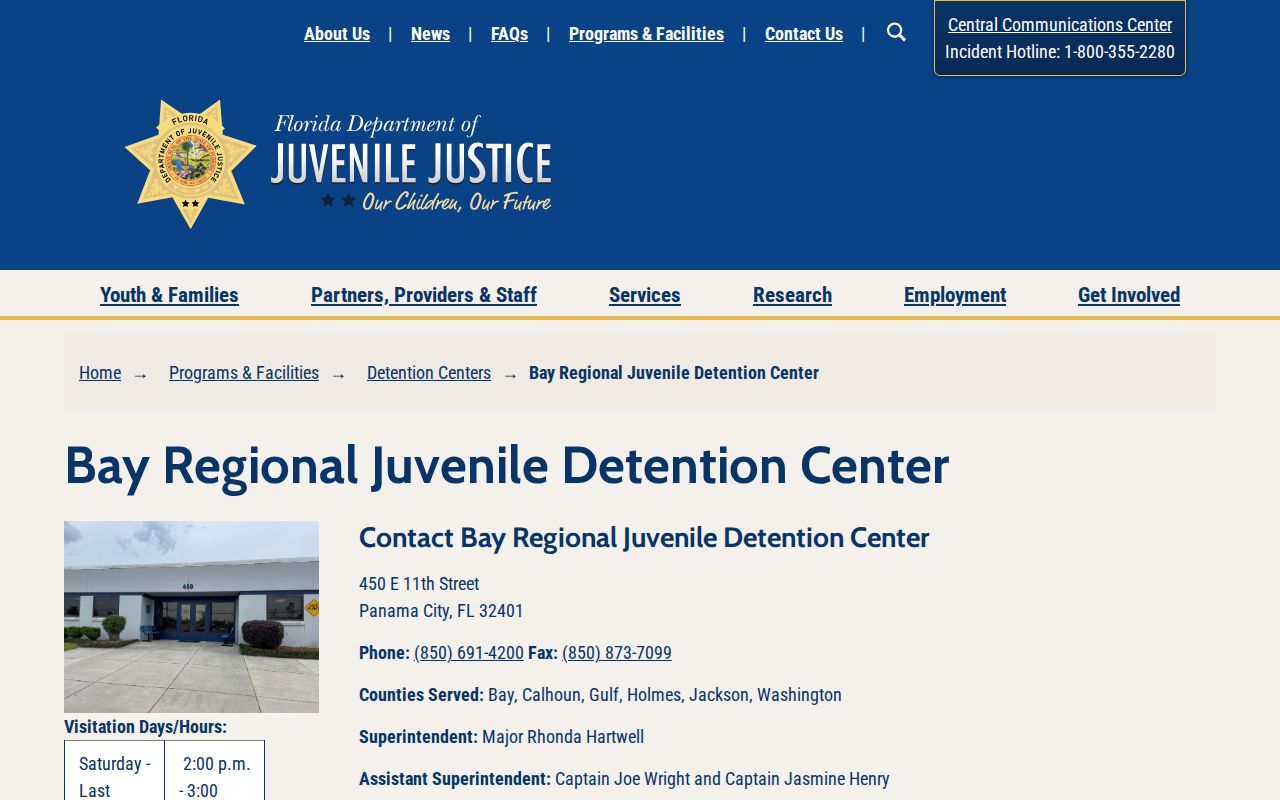
The source establishes that Bay Regional serves Jackson County youth while operating in Panama City. It does not expose an individual record or authorize a public release roster.
Jackson Youth Outside County
Bay Regional’s Panama City address can confuse a Jackson County search. The center serves six counties, so physical location does not change the originating juvenile case or the controlling DJJ and court channels. An authorized person should identify both the youth’s home or case county and the detention center when asking for routing.
The adult Jackson Clerk online criminal search is not a substitute for a juvenile record. County jail Booking cannot confirm a Bay Regional departure. FDC’s offender databases cover state prison and adult supervision populations, not this secure juvenile detention placement. BOP and ICE are also unrelated unless a separate, documented authority exists outside the juvenile matter.
When a person knows only that the youth left Bay Regional, three paths remain possible: guardian return, court or DJJ supervision, or commitment placement. Ask the authorized case contact for the official category. Do not seek the protected destination through a public name search or publish it after receiving private notice.
Bay Regional Guardian Return
A guardian return is planned through the case, not inferred from a court date. The authorized recipient, pickup time, identification requirements, transportation, supervision duties, and next hearing or service contact may all be case-specific. Confirm instructions before travel. The center serves a multi-county region, so assumptions based on a Jackson County courthouse schedule may be wrong.
If the plan changes, obtain updated instructions from the assigned professional. A later order can replace an earlier expected return. The order date and physical departure time may differ. Keep both facts in the private case file. Do not share pickup locations, guardian details, or a youth’s future address.
Florida Statewide VINE states that DJJ participates. An authorized registrant may use Florida VINE if the youth’s case and available profile permit notice. Event fields and wording depend on the agency feed. VINE does not become a general public youth locator, and an alert still needs confirmation through DJJ or the juvenile court.
Bay Regional Commitment Transfer
A commitment transfer moves the youth from secure detention to a residential program ordered or approved within the juvenile system. It is not release to the community. Bay Regional may stop being the current facility even though DJJ custody or authority continues. Describe the event as a transfer to commitment placement unless an authorized record uses another term.
DOVE Academy is one type of residential commitment program in Jackson County, but no individual connection should be assumed. The youth’s actual receiving placement is protected and case-specific. Adult county and prison locators do not track the transition. An authorized guardian or attorney should use the DJJ case contact for the destination and transition terms.
The distinction affects communication and compliance. A guardian pickup plan does not apply when the youth transfers to a program. Likewise, the end of secure detention does not mean the juvenile case ended. The disposition order and DJJ plan supply the controlling details.
Note: “No longer at Bay Regional” describes only the last location and cannot identify the youth’s next status.
Bay Regional Court Authority
Juvenile court orders can authorize detention, release, supervision, or commitment. Access depends on juvenile confidentiality rules and the requester’s role. An authorized party should obtain the current operative order through the attorney or court channel assigned to the case. Public adult docket access does not override youth protections.
Fourteenth Judicial Circuit victim-services information can help with local navigation and lists the Florida VINE number. It does not operate a second detention database and cannot replace DJJ or the juvenile court. Keep the support role distinct from custody verification.
If an order and facility direction appear inconsistent, pause and contact the assigned attorney or DJJ professional. A signed order can precede physical processing, or a later order may change the plan. Record the exact date and source inside the authorized file. Do not resolve the conflict through public posting.
Bay Regional Status Conflicts
Rumors, social posts, an unanswered facility call, and a missing adult search result are not release evidence. They are especially risky for a youth because a false claim can expose identity and location. The safe public conclusion is that no authorized person-level information is available.
An authorized person should compare the court order, DJJ case instruction, and actual transition notice. Each can describe a different stage. The order supplies legal authority. DJJ manages placement and supervision. Bay Regional handles the physical detention departure. Keep those roles attached to each date.
For historical proof, request the specific juvenile order or transition document through the responsible authorized channel. State the narrow event and date range. No response should be transformed into a public youth roster, photo gallery, or recent-release feed. Confidentiality remains part of accurate record handling, not an obstacle to work around.