
DOVE Academy Release Boundaries
DOVE Academy is a moderate-risk residential commitment program funded through Florida DJJ authority. It serves female youth ages 14 through 18 and has an operating capacity of 40. Those facts define the program, but they do not authorize publication of names, custody status, release dates, photos, or case details. A public adult-inmate workflow must not be applied to a youth.
A youth can leave DOVE Academy through a court and DJJ transition process, return to an authorized guardian, continue under juvenile supervision, or transfer to another approved placement. The word “release” must stay tied to the exact program and order. Leaving the Graceville program does not necessarily end juvenile court authority. A transfer ends the DOVE placement but continues care or custody elsewhere.
| DOVE transition | What it may mean | Authorized confirmation |
|---|---|---|
| Return to guardian | Residential placement ends under approved terms | Guardian, attorney, DJJ case contact |
| Community supervision | Program ends while juvenile authority continues | DJJ plan and juvenile court order |
| Transfer to another program | Placement changes | DJJ case contact |
| Court-ordered change | The judge changes placement or status | Authorized court record or attorney |
No row supports a public youth list. The correct path protects the youth while allowing authorized people to confirm a lawful transition.
Confirm DOVE Academy Transition
Begin with authority, not a broad name search. An authorized guardian should use the case contact, attorney, and juvenile court information already tied to the youth. An attorney should follow court and DJJ procedures. A person without authorization may receive no individual information, and that limit should not be treated as proof of either continued placement or release.
A careful authorized sequence is:
- Confirm the youth’s identity and the caller’s legal authority before requesting case information.
- Contact the assigned DJJ case or transition professional through established case channels.
- Review the juvenile court order that governs commitment, placement, supervision, or return.
- Ask whether DOVE placement ended through return, supervision, or transfer, using the exact official term.
- Protect all dates, addresses, identifiers, and youth records from public reposting.
The Jackson County custody map separates juvenile programs from the county jail, FDC prisons, and federal custody. Adult release feeds cannot fill gaps in a protected juvenile record.
DOVE Academy Confidential Records
Juvenile confidentiality changes both access and language. A youth’s name, age, photo, exact release date, guardian information, treatment details, and placement history should not be assembled into a public profile. Even when an adult criminal record would be open, the juvenile counterpart can be confidential, restricted, or available only to parties and authorized representatives.
Ask for the least information needed for the authorized purpose. A guardian may need the transition time, pickup instructions, supervision contact, or receiving placement. An attorney may need the controlling order and case history. A general member of the public does not gain access merely by knowing a name. Facility staff and DJJ can verify identity and authority before sharing case-specific facts.
- Commitment
- A juvenile court disposition placing a youth under DJJ authority for an approved program.
- Transition
- The planned move from residential placement to a guardian, supervision, or another setting.
- Authorized guardian
- A person legally permitted to receive the youth and protected case instructions.
- Transfer
- A move to another program or placement, not a public community release.
Do not copy protected details into adult search tools. The absence of an adult county or FDC record is expected and cannot verify the youth’s location.
DOVE Academy Contact Channel
The official facility contact identifies the program and can route an authorized inquiry. It does not operate as a public release line. State the relationship to the youth and use the case identifiers already provided through lawful channels. Staff may decline individual information until authority is verified.
DOVE Academy5270 Ezell Road
Graceville, FL 32440
Phone: 850-263-7550
Fax: 850-263-7685
Florida DJJ residential commitment program
The official DOVE Academy page supplies the program facts and contact represented below.
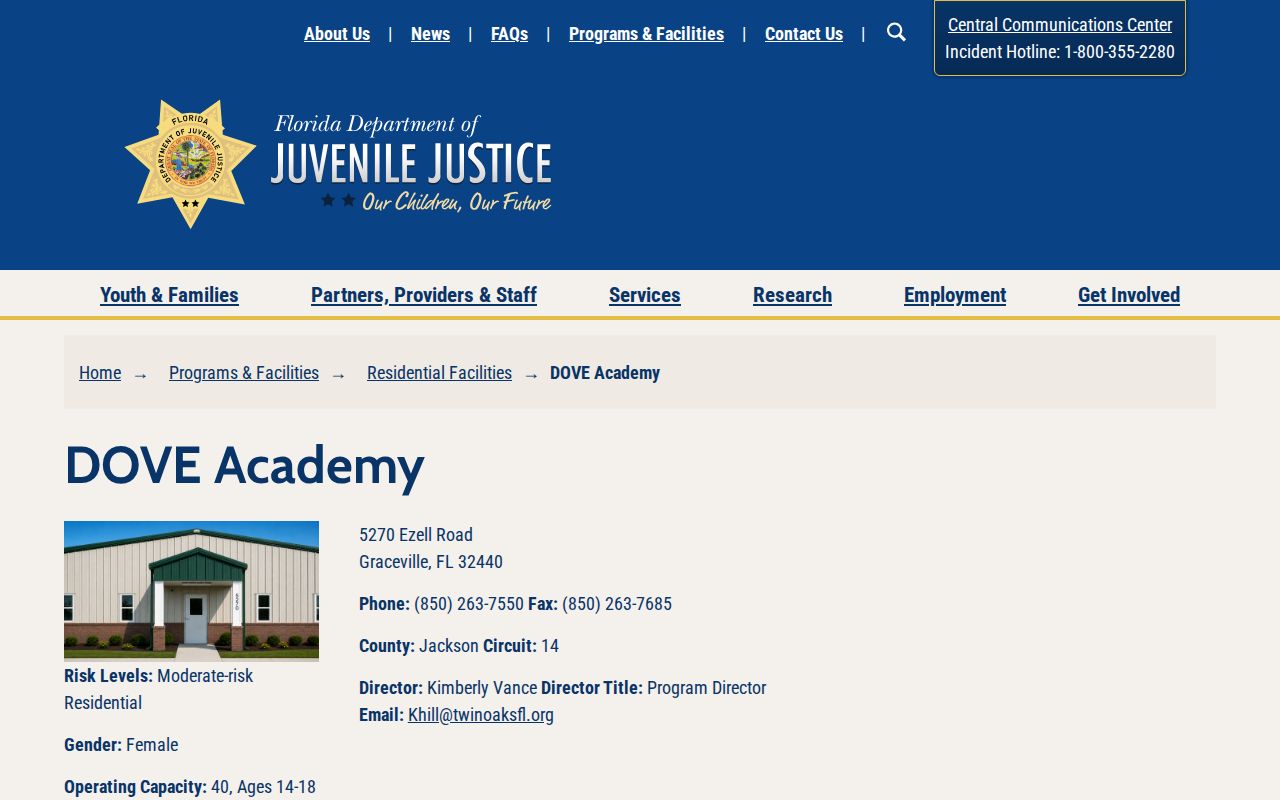
The official page confirms the program’s juvenile boundary without exposing an individual youth record or public release list.
DOVE is physically in Graceville and belongs to Circuit 14, but its youth records do not become adult Jackson County jail records. Use the assigned juvenile case route rather than the county correctional facility or county release-list request.
DOVE Guardian Release Planning
A return to an authorized guardian requires case-specific instructions. The approved recipient, time, location, transportation plan, supervision duties, and follow-up services can depend on the court and DJJ plan. None should be guessed from the facility address or a public web result. The authorized recipient should confirm instructions directly before travel.
If a departure changes to another placement, obtain the updated direction through the case contact. Do not call the move a release to the community. If supervision follows, record the supervising authority and start date in private case materials. A transition can end residential confinement while leaving court conditions in effect.
Florida Statewide VINE includes DJJ in official coverage statements, but event wording and availability can vary. An authorized person may use Florida VINE when the youth’s case and offered profile permit it. VINE is a notification layer, not an independent public youth database. Any alert should be confirmed through DJJ or the juvenile court, and protected details should remain private.
DOVE Court Release Authority
The juvenile court order supplies the legal authority for commitment and later changes. It may address placement, supervision, return, or another disposition. Access to the record is controlled by juvenile rules and the requester’s role. Adult Jackson OCRS results, county criminal dockets, and a public jail release entry are not substitutes.
An attorney or authorized party should use the court channel assigned to the case and ask for the operative order. A facility departure time and a signed order can be different facts. The order explains why the placement changed; DJJ and the program manage the physical transition. Keep both in the private case file when proof is needed.
Fourteenth Judicial Circuit victim-services materials can provide local navigation and the Florida VINE number. That office does not operate another custody database. Its role is support and routing, not public disclosure of a DOVE youth’s status.
Note: The court and DJJ record govern the transition, while adult release searches should remain outside the youth’s verification path.
DOVE Transfers Are Not Releases
A transfer can occur when DJJ or the court changes the youth’s program or level of care. It ends the physical DOVE placement, yet juvenile authority continues. A person who only knows that the youth is “no longer at DOVE” cannot determine whether the youth returned to a guardian, moved to supervision, or entered another placement.
Authorized contacts should ask for the official transition category rather than a destination that may be protected. The distinction matters for pickup, communication, and case compliance. Public callers should accept that staff may provide no person-level answer. Searching adult jail, FDC, BOP, or registry systems would not repair that access limit and can produce a false match with an adult of the same name.
DOVE Academy and Bay Regional serve different juvenile functions. DOVE is a residential commitment program, while Bay Regional is secure detention pending adjudication, disposition, or placement. A youth can move through different parts of the DJJ system without experiencing an adult-style release. Facility type must stay attached to every description.
DOVE Record Conflict Rules
If an authorized order and facility instruction seem inconsistent, contact the assigned attorney or DJJ case professional before acting. A later court order may replace an earlier plan, and the physical transition may occur after the order date. Write down the date, source, and exact wording without sharing it publicly.
Do not infer status from social media, rumors, an unanswered phone call, or absence from a public system. The safe conclusion is only that the public source cannot answer the question. Identity errors carry special harm in a juvenile context. Use lawful identifiers inside the authorized case channel and avoid circulating them.
For historical proof, an authorized person should request the specific order or transition document through the responsible juvenile authority. Narrow requests protect confidentiality and make clear which event needs verification. No public roster, gallery, or recent-release list should be created from the response.
Confirm which document is current. A draft plan, expected date, and final signed order can describe different stages. Only the authorized case channel can resolve that sequence without exposing protected youth information.